There is a Japanese idea that the 帰り道 — the way home — is the best part of the day. Not the destination, the walk: the light going orange, the school bag on one shoulder, the stop you make without deciding to. Japanese songs, novels and films are full of this hour. Here it is in four pictures.
The gate that glows first
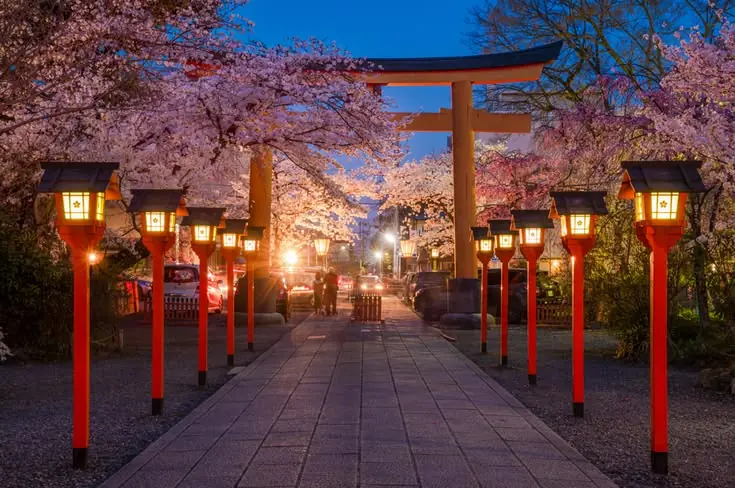
At dusk in spring, a shrine approach looks like this: the vermilion torii standing in the middle of the path, lanterns switched on one by one, cherry trees catching the last blue light and the first warm bulbs at once. People pass through on their way home from work, some stopping, most just walking — the gate does not require anything of them.
The character 鳥 means bird and 居 means to dwell; a 鳥居 is literally where the bird sits — the boundary between the ordinary street and sacred ground. You cross a hundred of them in a year of anime without noticing. Now you will notice.
Dusk words
- 帰り道かえりみちthe way home
帰る (かえる, to return) + 道 (みち, road). One of the loveliest everyday compounds in Japanese.
- 鳥居とりいShinto torii gate
You will see this at the entrance of every shrine. No space between the two characters.
- 夕方ゆうがたevening, dusk
Not 夜 (よる, night) — 夕方 is the golden hour before dark. 夕方六時 — six in the evening.
- 夜よるnight
Learn the trio: 朝 (あさ morning), 昼 (ひる noon), 夜 (よる night). Almost all N5 time words.
The lane with the mirror
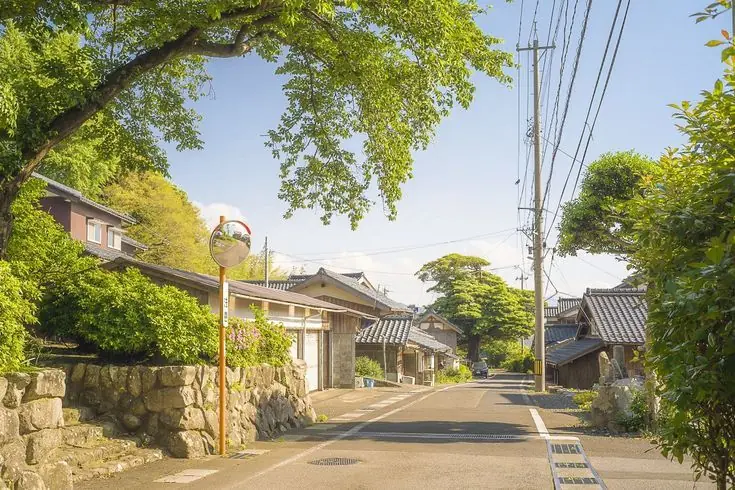
This is what a Japanese side street looks like when nothing is happening: a stone wall, a cherry tree, the round traffic mirror that exists so two people on bicycles can pretend they did not almost meet. Tile roofs, hedges, a road painted with a single white line — and absolutely nobody rushing.
It is also, unmistakably, the lane from someone's walk home. Every Japanese person has a version of this street — tile roofs, hedges, a road painted with a single white line — and the fact that you can picture yours, even if you have never been, is what writers mean by 帰り道.
The train that runs beside the water
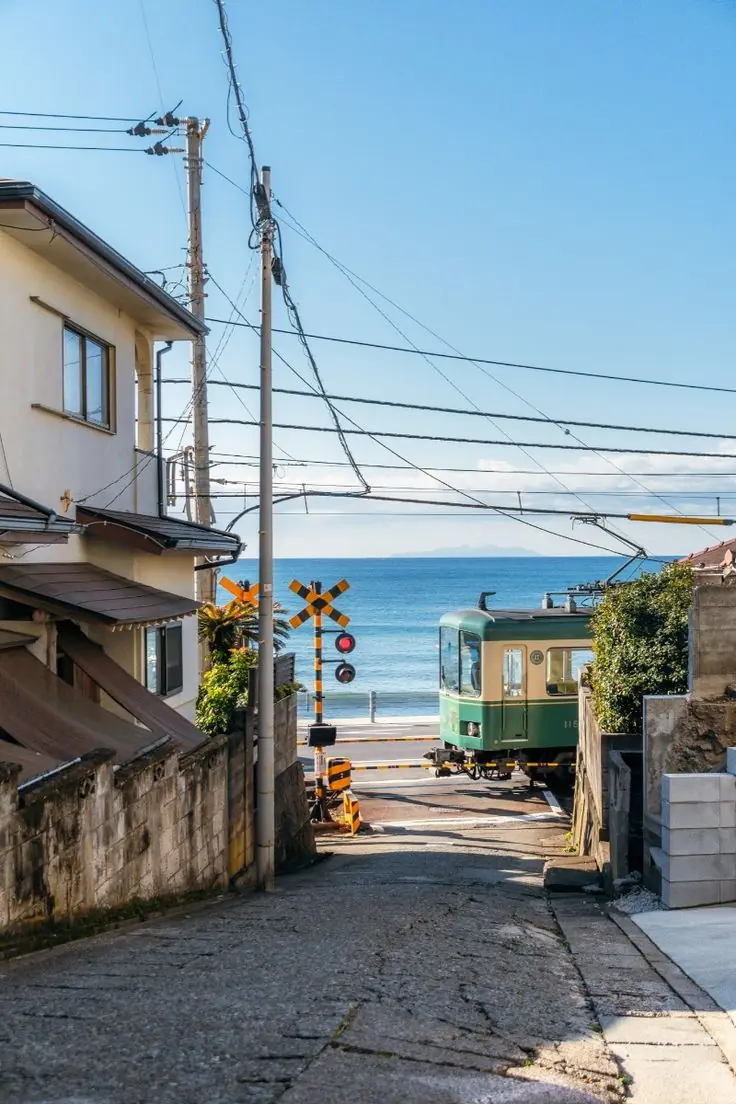
Some commutes end at a crossing like this one: a small green tram, the bell about to ring, and the Pacific filling the gap between the houses. The tracks run at street level through neighbourhoods, so the rhythm of the day — and the sound of the 踏切 bell — is folded into ordinary life.
Trains are where Japan does its thinking. Students doze standing up, office workers read novels, everyone knows which door to stand by. If the road home is a Japanese ritual, the railway is its stage.
On the way
- 電車でんしゃtrain
電 (electric) + 車 (vehicle). 家に電車で帰る — I go home by train.
- 踏切ふみきりlevel crossing
踏む (ふむ, to step on) + 切る (きる, to cut). The place where the road is cut by the tracks.
- 海うみsea, ocean
川 (かわ, river) and 海 (うみ, sea) travel together in N5 lists. Both are read with native Japanese readings here.
- 帰るかえるto go home, to return
A 五段 verb: 帰ります (polite), 帰った (past). One of the first verbs you will actually use.
The light before your door
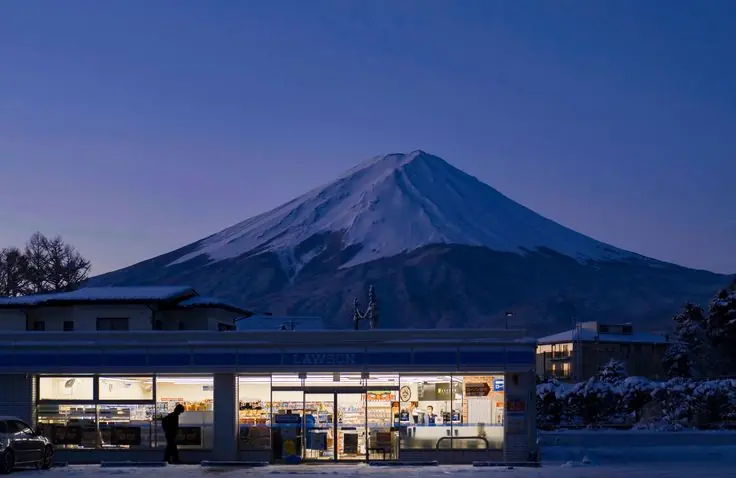
Mount Fuji at blue hour, snow on the ground, and a convenience store burning warm in the foreground. In the cities, this is the final scene of the 帰り道: you buy something you did not need — a hot coffee, an onigiri — because the walk home deserves an ending.
コンビニ are open all night, always lit, always the same three colours of light wherever you are in Japan. Psychologically they are less a shop than a waypoint: proof that you are nearly home. Photographers chase this exact view; residents see it on the way back from the station.
Every language has a word for home. Japanese also has a word for the walk that gets you there.
Your own way home
The reason 帰り道 matters for learners is bigger than vocabulary. It is a daily moment you already have — the walk from class, the bus, the desk to the kitchen — and it can belong to Japanese too. Ten minutes, headphones off, naming what you pass in Japanese: road, sky, shop, light.
Four pictures, four ways of arriving somewhere. Take the phrase with you: 帰り道、頑張る。The way home is also where the day's studying finally settles in.
Last stop
- コンビニこんびにconvenience store
Short for コンビニエンスストア. Every N5 traveller should know this one by heart.
- 冬ふゆwinter
The last of the four seasons: 春夏秋冬. Winter scenes like this one arrive with the first snow.
- 雪ゆきsnow
雪が降る (ゆきがふる) — snow falls. Seen here on Fuji's shoulders.
- 道みちroad, way
帰り道, 千里の道 — the character for "road" carries "way/path" in the abstract too.
✍️ Try it yourself
Tonight, on your actual way home or between rooms, describe three things you see in Japanese — one noun, one verb, one colour. 帰り道の練習です: this is way-home practice, and it counts as studying.