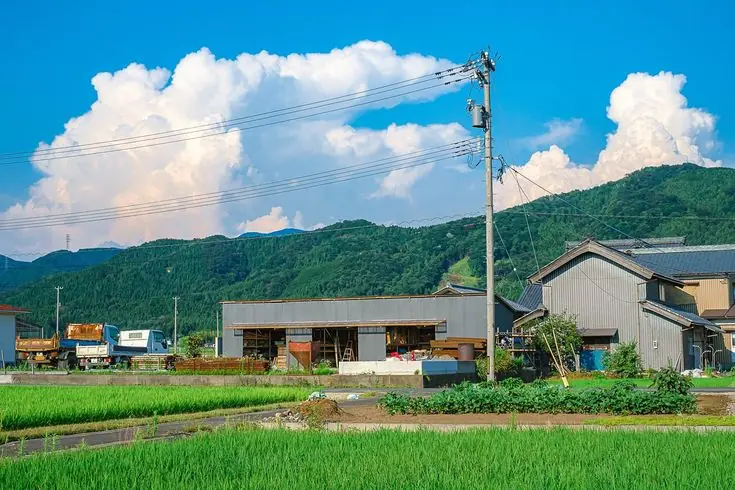
Ask someone outside Japan to picture the country and they will say Tokyo, Kyoto, Mount Fuji. Ask a Japanese person where summer really lives and they will say 田舎 — the inaka, the countryside. Not a destination exactly, but a feeling: rice fields running right up to the front door, clouds stacking up over the hills, and nobody hurrying anywhere. These five photographs are from that Japan.
Clouds that look like mountains
There is a word for these clouds: 積雲 (しきうん), cumulus — but Japanese people usually just call them 夏雲 (なつぐも), summer clouds, or more poetically 入道雲 (にゅどうぐも), because they look like the shaved head of a Buddhist monk rising over the mountain. Children learn that word in elementary school and never forget it.
Below them, the rice is at its greenest. Japanese summers are measured in this green — rice is planted in June, grows through the hottest weeks, turns gold in September, and the whole calendar of school holidays, festivals and fireworks hangs off that cycle. For a learner, 夏 is one of the four seasons you must know for N5; for everyone else here, it is simply what the year feels like.
Words of the fields
- 田舎いなかcountryside, hometown
Literally "rice-field house." 田 (た, paddy) + 舎 (しゃ, cottage). 帰る田舎 — the hometown you return to.
- 稲田いなだrice paddy
稲 is the rice plant itself. You will see 稲 everywhere in rural place names.
- 雲くもcloud
Watch out: 雲 reads くも, but 階段 (かいだん, stairs) — no cloud in it at all. Japanese rewards patience.
- 自然しぜんnature
The 自 in 自分 (myself) — nature and self share a character in Japanese thought.
The landscape that repeats
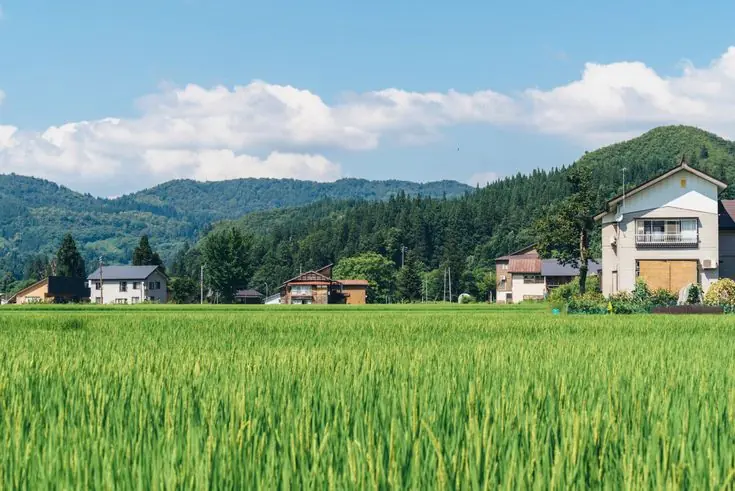
Take a local train away from any Japanese city and this is what passes the window, kilometre after kilometre: paddy, house, paddy, warehouse, paddy, mountain. It looks monotonous and is not — every valley has its own shrine, its own river, its own opinion about the best rice.
This is also the landscape of a thousand anime openings: a girl on a bicycle, a train crossing, laundry on a line. Once you can name what you are seeing — 山, 川, 田, 家 — those scenes stop being background and start being reading practice.
Where the forest begins
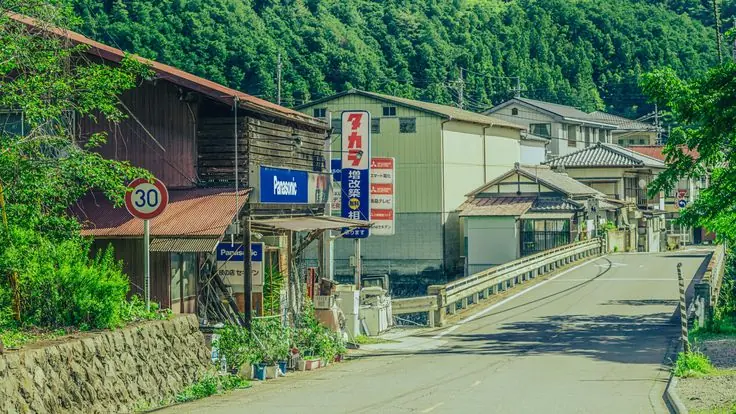
In the inaka the street does not end at a shopping district — it ends at trees. Wooden storefronts, a sign for the electronics shop that opened in 1985 and never closed, a speed limit of 30 because children still play on the road. Village life in Japan is organised around exactly these few hundred metres.
Notice how much of the signage is in kanji and hiragana you already know. Real Japanese practice is not trapped in textbooks; it is standing on a lamppost waiting for you to walk past it.
The shop with no shopkeeper
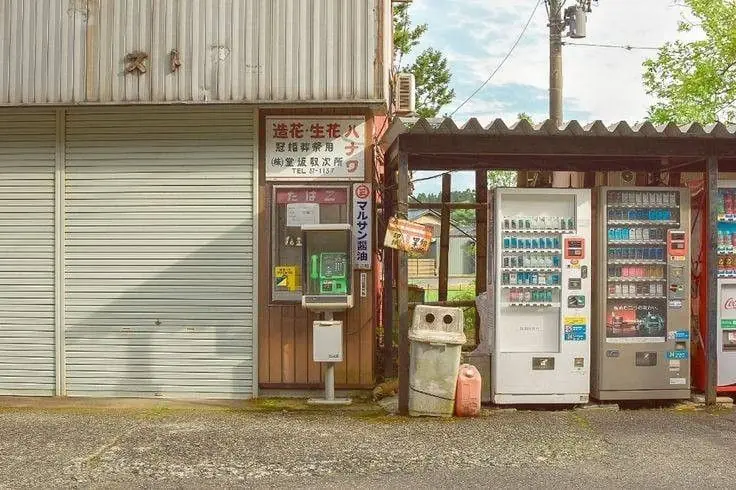
This may be the most Japanese photograph in the whole journal: a wooden shopfront with a hand-painted sign for funeral and wedding flowers, an honour box, and two vending machines standing guard. Nobody is at the counter. Nobody needs to be. Trust is part of the architecture.
Japan has over five million vending machines — roughly one for every twenty-three people — selling tea, coffee, soup, umbrellas, and occasionally rice and eggs in farming towns. 自動販売機 (じどうはんばいき) is a long word, but you will meet it on your first walk anywhere in the country, so it is worth locking in now.
Small-town words
- 自動販売機じどうはんばいきvending machine
自動 (automatic) + 販売 (sale) + 機 (machine). Colloquially shortened to 自販機 (じはんき).
- 買うかうto buy
One of the most common N5 verbs. 飲む (のむ, to drink) is its usual partner: コーヒーを買う.
- 花はなflower
The sign reads 造花・生花 — artificial and fresh flowers. 生 reads なま/い here, not せい.
- 静かしずかquiet
You met this word in our first journal. Here it is again — the inaka version: so quiet you hear the vending machine hum.
Waiting for the bus
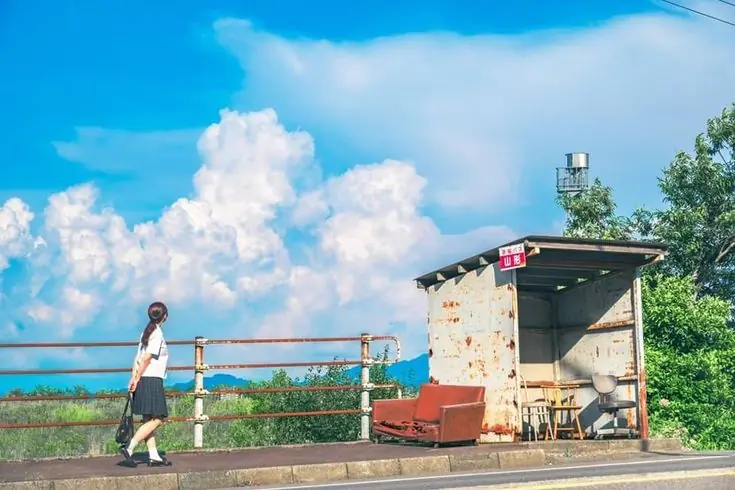
A student in summer uniform waits at a stop that appears to have been furnished by a living room: an old sofa, a table, chairs under a rusted shelter. This is the inaka version of a commute — unhurried, slightly absurd, completely safe.
The clouds behind her are doing what Japanese summer clouds always do in photographs and in memory: growing enormous while nobody watches. If this frame looks like an anime still, that is because animators have been painting exactly this scene for forty years. Learn the words and the whole genre opens up.
The countryside is not far from the city. It is simply where the hurry stops.
How to visit without a train ticket
You do not need to book a flight to stand in a place like this. Rural Japan is all through anime, film and travel vlogs — and now through photographs like these. The trick is to watch actively: pause, name the rice field, the cloud, the vending machine, the stone wall in Japanese.
That is the whole method of this journal. Pictures give you a reason to remember words; words give you a way back into the pictures. 田舎の夏 is a small phrase, but if you can describe what you see in it, you have already crossed from memorising Japanese into using it.
Weather and time
- 夏なつsummer
四季 (しき, four seasons) vocabulary is core N5: 春夏秋冬. 夏休み (なつやすみ) — summer vacation.
- 暑いあついhot (weather)
Two 暑: 暑い = hot weather, 熱い = hot to the touch, 厚い = thick. A favourite exam trap.
- 山やまmountain
Back again — mountains are never far in these photographs, and never far on the test either.
- バス停ばすていbus stop
外来語 (borrowed word): bus + 停 (stop). Easy points if you can read katakana.
✍️ Try it yourself
Next episode you watch, pause on an outdoor scene and name five things in Japanese — 雲, 道, 家, 空, 木. If you can do that without hesitating, your reading speed is improving faster than you think.