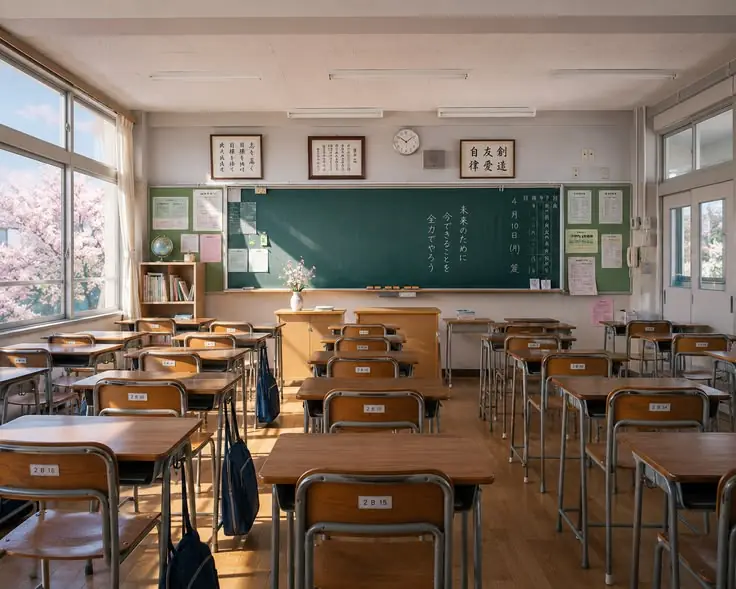
If you have ever watched a Japanese anime or drama, you already know this room: rows of wooden desks, a green blackboard at the front, bags hanging from the sides of chairs, and a window full of cherry blossoms. The classroom is one of the most recognisable rooms in Japanese culture — and one of the most useful places to learn vocabulary from, because everything in it is a word you will meet on the JLPT.
Read the blackboard first
The message on the board is worth slowing down for. 未来のために — "for the future." 今日もよく頑張りました — "you worked hard today too." Japanese classrooms end most days with a teacher's closing remark and a shared bow, and the encouragement written up front is typical: study is framed as something you do for the person you will become.
Above the board hang framed calligraphy — 自律 (じりつ, self-discipline) and 友愛 (ゆうあい, friendship) — values posted in almost every school in the country. A clock, a bulletin board with the class roster, books lined up by the door: nothing here is decorative. Every object in the room is a vocabulary item waiting to be learned.
Words in this room
- 教室きょうしつclassroom
教 (teach) + 室 (room). 教室はきれいです — the classroom is clean.
- 黒板こくばんblackboard
黒 (くろ, black) + 板 (いた, board). The green board is still called 黒板.
- 机つくえdesk
Careful: 机 means desk, but 椅子 (いす) means chair. Both are in every N5 list.
- 先生せんせいteacher
Used for doctors and lawyers too. Add は before a name: 田中先生.
April: the season of beginnings
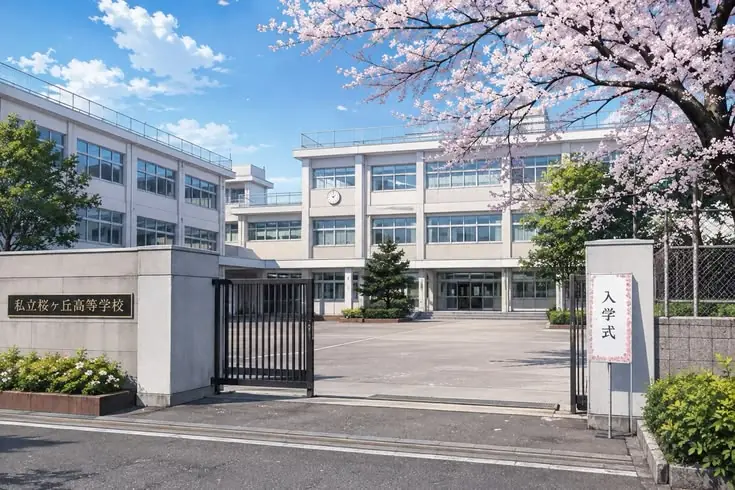
Japanese schools start in April, right in the middle of cherry blossom season, and the banner at the gate says why everyone is here: 入学式 (にゅうがくしき), the entrance ceremony. New students line up in uniforms they have never worn before, families take photos at the gate, and everyone pretends not to notice the parents who are crying.
The school's name on the wall is a small lesson in itself: 私立 (しりつ, private) 桜ヶ丘 (さくらがおか, "cherry-blossom hill") 高等学校 (こうとうがっこう, high school). Long compound words like these look intimidating until you break them into pieces — a skill you will use on every JLPT reading question.
School words
- 学校がっこうschool
学 (study) + 校 (schoolyard). 学校に行く — to go to school.
- 入学式にゅうがくしきentrance ceremony
入学 (enter school) + 式 (ceremony). Held every April 8th or so.
- 授業じゅぎょうclass, lesson
授業がある — to have a class. 授業中 (じゅぎゅうちゅう) — during class.
- 放課後ほうかごafter school
The setting of a thousand anime scenes. Note the 促音 (っ) in the middle.
Forty students, one photograph
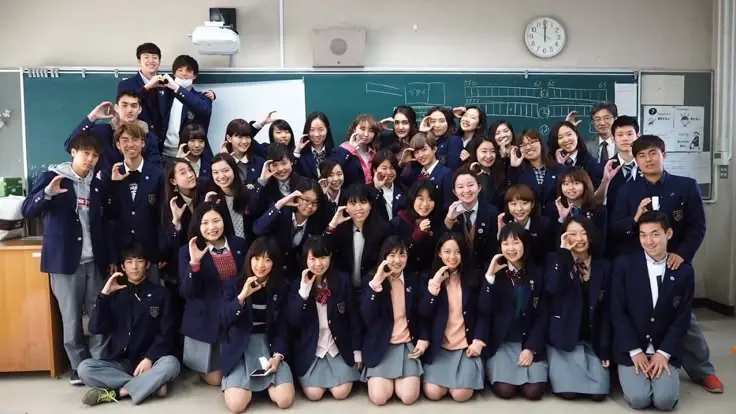
This is what the room looks like when it is full. Navy blazers, plaid skirts, the blackboard wiped clean behind them — and nearly every student making the same finger-heart or circle gesture at the camera. Class photographs are a ritual: the whole grade gathers, the teacher says the count, and someone always blinks.
Japanese school life has a rhythm you can feel even in a still image. Morning homeroom (朝の会), six or seven classes with ten-minute breaks, lunch eaten at the desks (給食), then club activities (部活動) that run until evening. Friendships formed in these rooms tend to last a lifetime — a fact that shows up constantly in Japanese films and novels.
People and routines
- 学生がくせいstudent
生徒 (せいと) is used for junior and senior high students specifically.
- 友達ともだちfriend
友 + 達 (plural marker). 友達になる — to become friends.
- 制服せいふくschool uniform
制 (system) + 服 (clothes). Uniforms are worn from junior high onward.
- 勉強べんきょうstudy
勉強する — to study. 勉強が好きです — I like studying.
An empty classroom is just a room. A classroom full of people is where a language starts.
Your classroom, wherever it is
You may never sit in a Japanese classroom — or you may be building one right now at your desk at home. Either way, the vocabulary in this article is the same vocabulary that appears in the JLPT N5 syllabus: 教室, 先生, 勉強, 放課後. Words like these are not abstract; they belong to a real room with real sunlight in it.
Look at these three photographs again and name what you can in Japanese. If you can describe a classroom, you can already write your first simple paragraph — and that is a real piece of the exam done.
✍️ Try it yourself
Challenge: write three sentences in Japanese describing your own classroom using 教室, 机 and 先生. Five minutes, no pressure — it is exactly the kind of task the writing section rewards.